
Tiber Valley
Listen to the audio-guide
The Montone area is bordered on the south-west by the Tiber River, and on the north and north-east of the town by the Carpina, the Tiber’s left-hand tributary, and the Carpinella stream which descend from their respective valleys, while the Lana stream forms most of the western boundary.
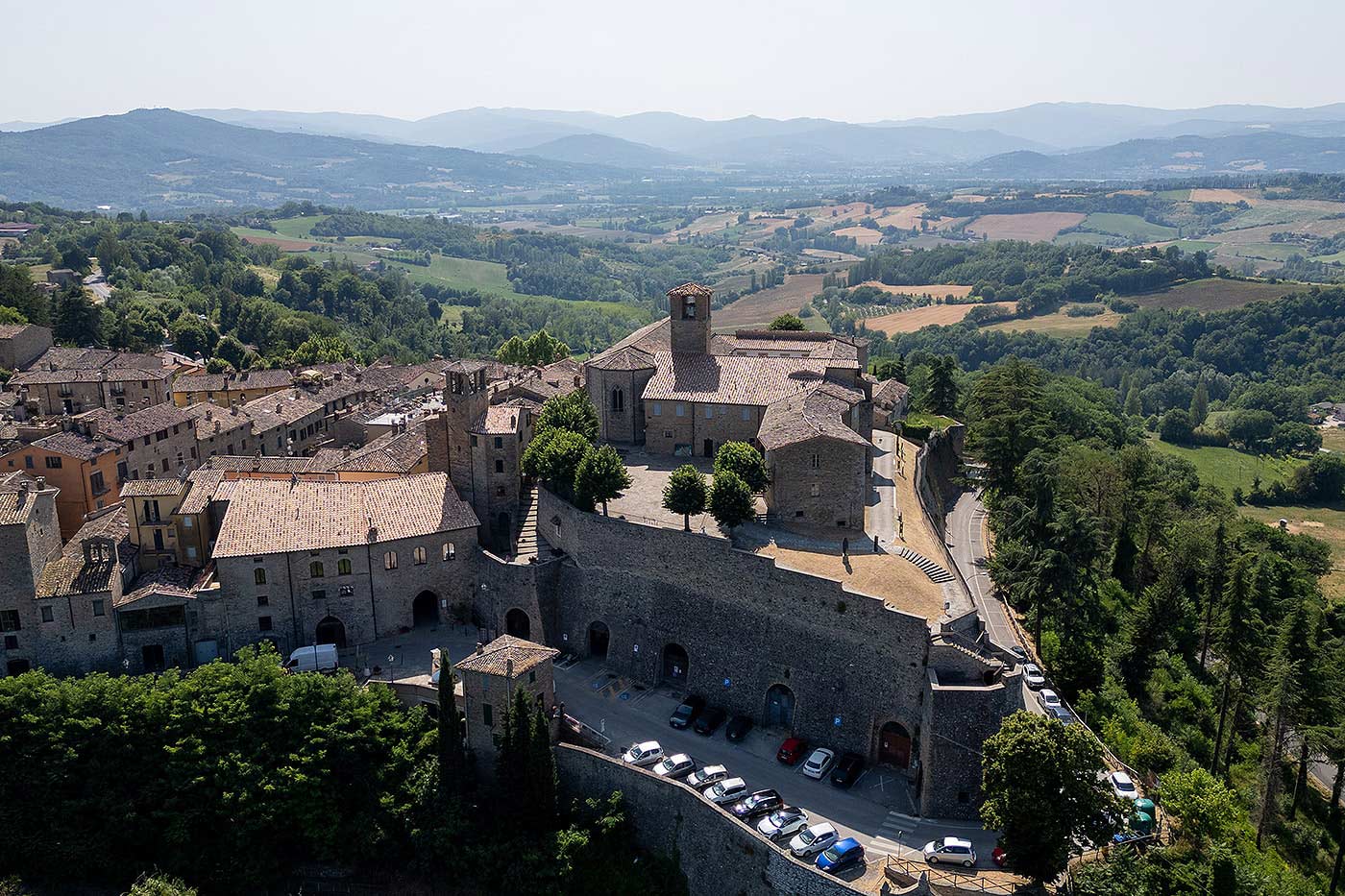
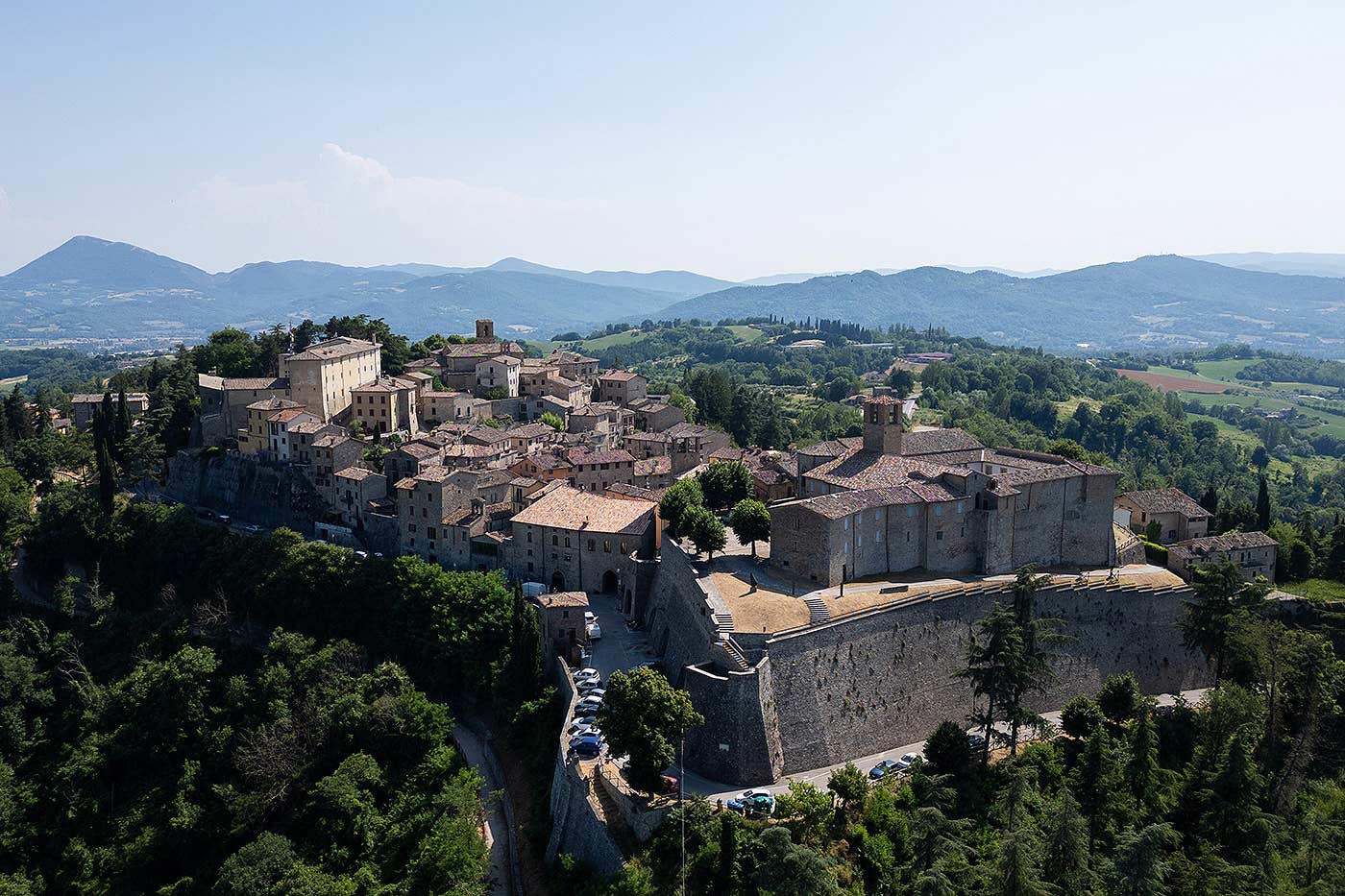
The Capanneto or Castel Vecchio occupied the hill where the convent of St. Francis now stands. At the top of the hill, on either side of the primitive fortress, two vast terraces enabled control of the Tiber Valley to the west, and the Carpina river valley to the east.
The west-facing terrace offers a panoramic view from Mount La Verna to the northwest to Mount Tezio near Perugia. The course of the Tiber in this stretch has created a wide plain beyond which rise the verdant hills that mark the border with Tuscany.
Archaeological evidence reveals that the area between the Tiber and the Carpina was inhabited as early as the Middle Palaeolithic period. Various other finds show that the area was still permanently inhabited in the Bronze Age, when the Umbrian and Etruscan peoples lived on either side of the Tiber. They often chose elevated locations that allowed them to easily control the communication routes.
During Roman times in the 2nd century, there was a luxurious country villa at Santa Maria di Sette, near the confluence where the Carpina flows into the Tiber. The inhabitants benefited greatly from the fertile plain surrounding it. The area had been frequented repeatedly during much earlier periods, probably as a place of trade. It would have been linked to the transport of goods along the river, and also due to the important diverticulum, or side road. This branched off the main road towards Tifernum Tiberinum, and provided a more direct route to Pietralunga before it passed through Cagli on the Via Flaminia.
The course of the Tiber in this stretch has created a wide plain beyond which rise the verdant hills that mark the border with Tuscany. The main communication routes between Rome and Ravenna – the Via Flaminia and the Via Amerina – constituted an important objective for occupation by the battle lines. By the end of the 6th century, the Lombards had conquered much of northern Italy and Tuscia as far as Arezzo; they governed the duchies of Spoleto and Benevento. Only a thin strip of land continued to connect Rome and Ravenna, passing through Perugia. Between 590 and 605 Città di Castello also fell into the hands of the Lombards and the upper limes of the Byzantine corridor inevitably moved to the Carpina and Niccone valleys. The line of defense consisted of a series of castles, fortified squares and fortresses, placed at the top of the hills, which, although modest in size, ensured control of the communication routes and guaranteed the safety of agricultural production in the valleys.
It is likely that one of these ancient fortified sites was built much later, about two or three centuries after the castle of Montone.
One of the main factors that influenced its development was its strategic position. This is evidenced by the ongoing struggle between Perugia, Città di Castello and, to a lesser extent, Gubbio, to gain control of it. It was a border land, on the edge of three dioceses, and its subjection was disputed between these three great cities and their “masters”, the Papal State on one side and the Empire on the other. In the first fifty years of the 13th century it changed hands twice before finally ending up permanently under the dominion and protection of Guelph Perugia in 1248.

Discover one of the most beautiful villages in Italy
©2026 Montonein | Cookie Policy | Privacy Policy
site created by Made in Italy Lab