
The Church of San Francesco
Listen to the audio-guide
In 1308, some citizens were forced by the municipality to sell their land and homes so that the Minori, who had been present in Montone since the time of San Francesco, could build the convent and church infra muros within the walls.
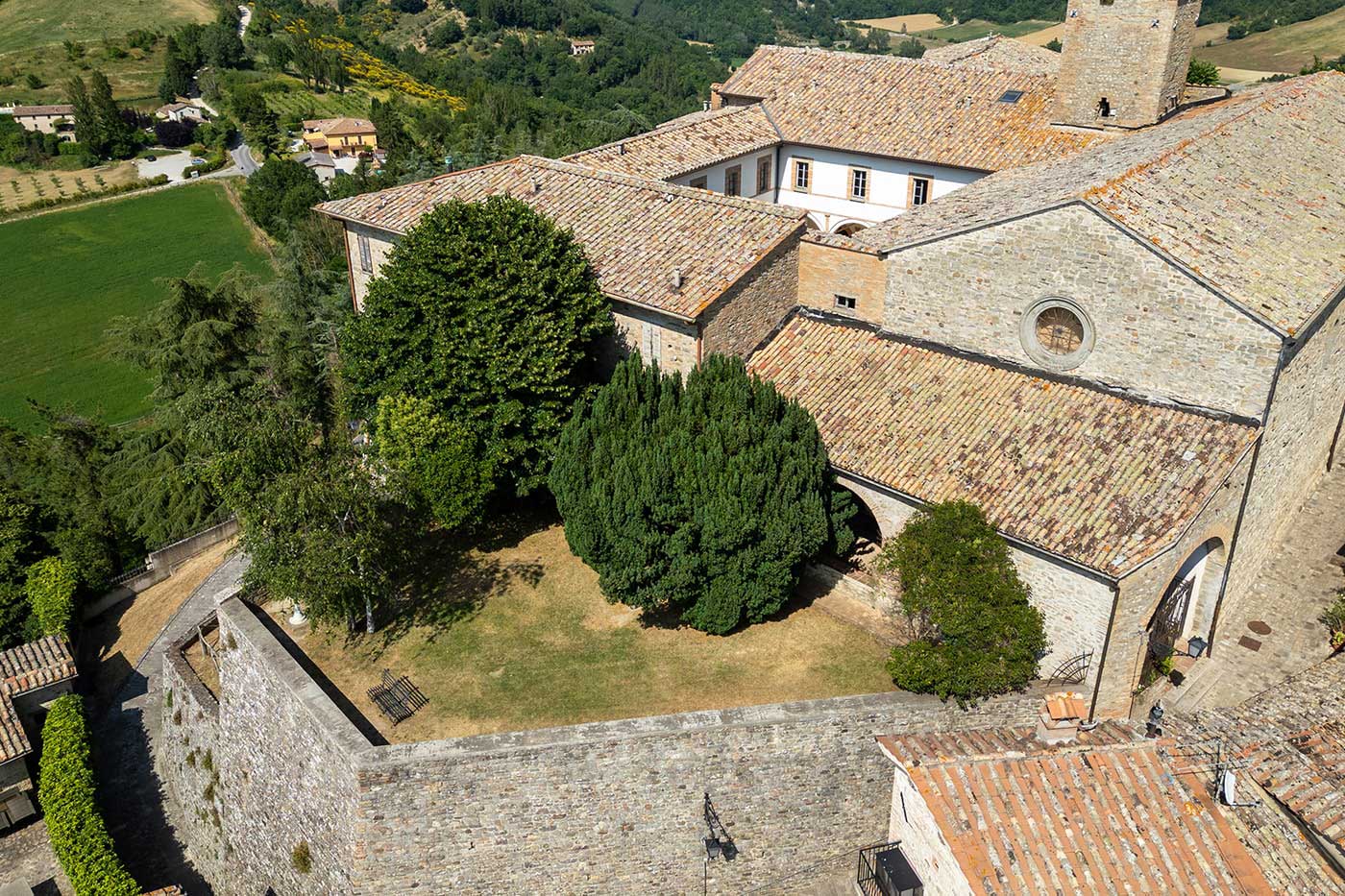
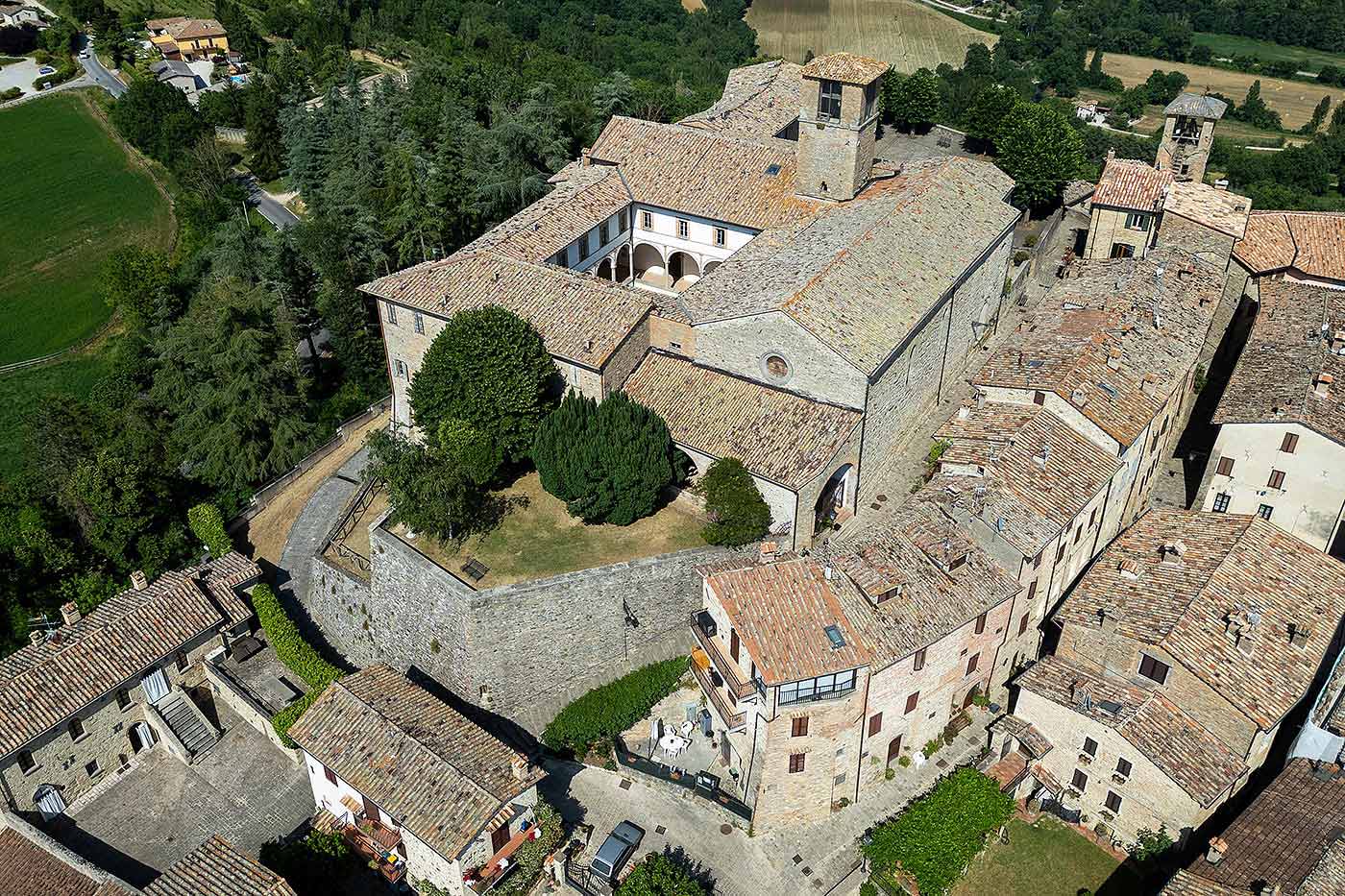
The church was therefore built at the beginning of the 14th century, in accordance with the typical architecture of mendicant orders so grandiose in structure and modest in its simplicity. Canonical in design with a west-facing façade, it has a single nave embellished with a polygonal apse introduced by another pointed arch. The hall is covered by a ceiling roof truss with a powerful entablature. Along the walls, six single-lancet windows provide lighting for the interior, together with the central mullioned window of the apse and the two side single-lancet windows. On the façade, an undecorated rose window overlooks the portico which was probably built between the 17th and 18th centuries.
Inside, the church looks very different from its original appearance. In the early 16th century, the walls must have been completely covered in frescoes, but during the Napoleonic invasion, the church and convent were set on fire and most of the frescoes were destroyed.
Of all the frescoes, only fragments remain which are indications of the richness of the decoration.
The layer of paintings from the first decorative phase, dating back to the second half of the 14th century, consists of a series of consecration crosses and a large number of votive frescoes of varying quality. They show the influence of Umbrian-Perugian culture, which reworked models taken from the Assisi school and spread among local painters until well into the 14th century.
The richly frescoed apse which was painted by Antonio Alberti da Ferrara between 1422 and 1424, thanks to the patronage of Braccio Fortebracci, Count of Montone, also suffered devastation and alterations. Where much of the painted plaster has fallen away to reveal the rough coat, it is still possible to make out the pictorial composition which is due to the presence of sinopia (reddish-brown pigment).
In the second half of the 15th century, most of the 14th-century decorations throughout the church were ‘replaced’, due to the tireless fundraising efforts of Stefano Cambi, guardian of the convent from at least 1464 until the early 16th century.
The main sponsors of the church renovation works were the Fortebracci family, and the town institutions themselves. The community took on the construction of two different chapels, one dedicated to Saint Sebastian and the other to the Virgin Mary. The first was built in 1464 and completed with frescoes by Berto di Giovanni in 1514; the second was commissioned in 1471 and since 1482 it has housed the sumptuous banner of the Madonna della Misericordia, created by Bartolomeo Caporali.
Caporali was also involved in the artistic decoration of the altar dedicated to Saint Anthony of Padua, on the opposite side of the church. Commissioned by Carlo Fortebracci and Margherita Malatesta to commemorate the birth of their son Bernardino, the altar was completed in 1491.
The church’s most famous work is the so-called Pala di Santa Cristina by Luca Signorelli, created by the Cortona painter in 1515 in cordiale amicitiam (in cordial friendship) for his personal physician, owner of the chapel, who lived in Montone. The altarpiece depicting the Madonna and Child with Saints in the painter’s typical monumental style, was sold to the National Gallery in London in 1901 and has been replaced with a copy.
The church’s decoration was completed with wooden furniture, most of which was lost in the fire of 1798.
All that remains is the valuable choir with thirteen pews, built in walnut at the end of the 15th century, the bench for the Domini sex and magistrates with inlaid frames and backrests, dating back to 1505, and the large double door in carved walnut, made in 1519 by Antonio Bencivenni, who in 1501 had made the doors of the Collegio del Cambio and the choir of the church of San Domenico in Perugia.

Discover one of the most beautiful villages in Italy
©2026 Montonein | Cookie Policy | Privacy Policy
site created by Made in Italy Lab