
The Origins of Montone (the castles and the Rocca d’Aria)
Listen to the audio-guide
Montone stands on a hill wedged between the Tiber River and the Carpina, a tributary on the left.
Following the fortification process of the post-Carolingian era when internal struggles within the empire saw the people build both public and private fortresses, six castles were built in this area.
Only one of the six castles, however, underwent urban development. The Capanneto had an abundance of water, easy transport links and, last but not least, a castrum which facilitated its defence, due to its central position compared to the others.
The traces of the castles of San Pietro and Montefalcone are still visible at their respective sites, and Rocca d’Aria or Cardaneto still exist. There is no longer any trace of Poggio which was located on the hill where the monumental cemetery of Montone now stands.
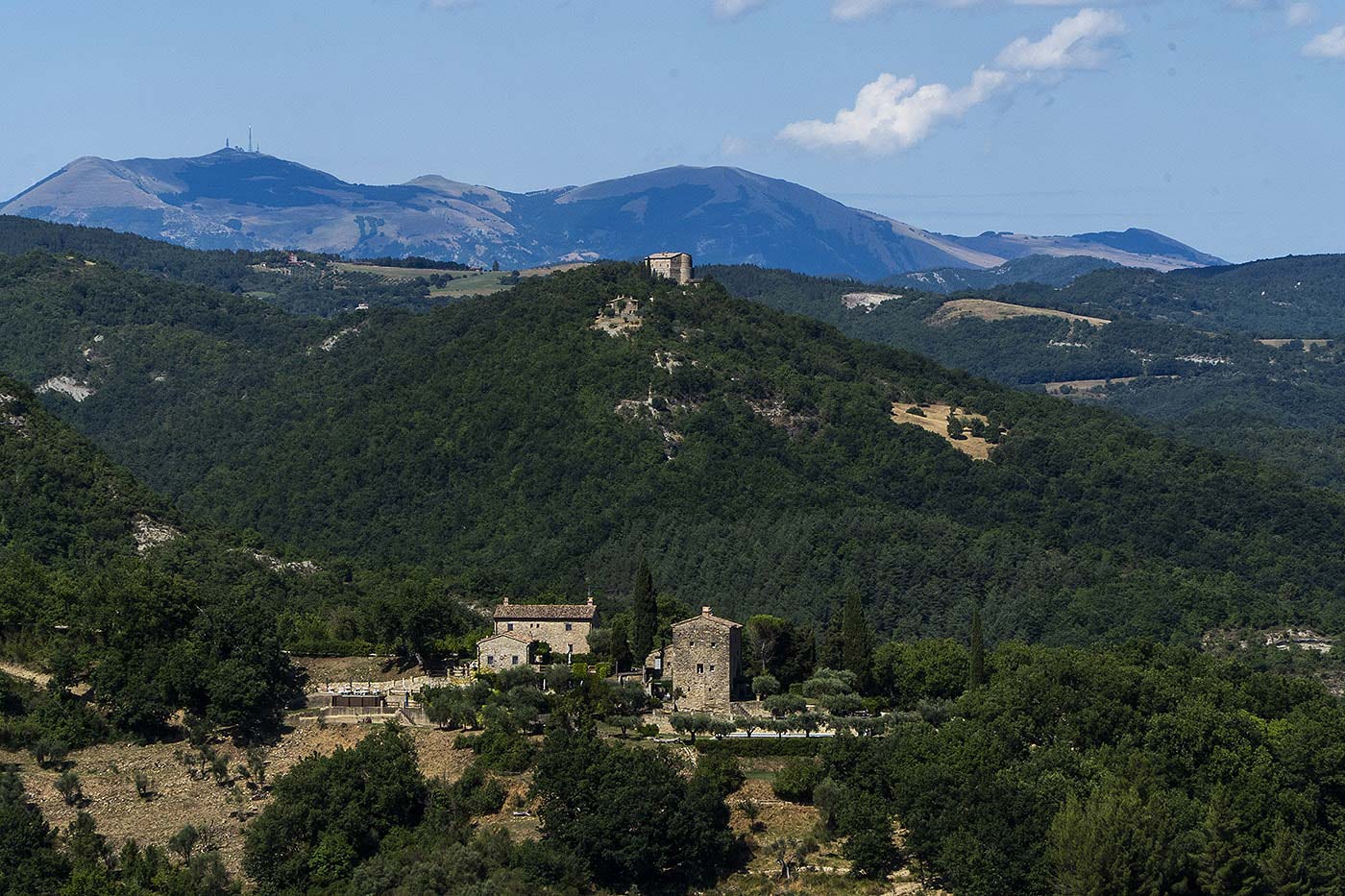
While looking to the north-east and tracing the course of the Carpina, one can clearly see the outline of the Rocca d’Aria.
This legendary ancient manor that over centuries has fuelled the imagination of local historians and inspired countless stories, is always referred to in documents as Rocca d’Ara or d’Aria.
It bears striking similarities to other castles in the area which suggests that this primitive structure was built between the 10th and 11th centuries, like Castel Vecchio.
In 1260, Cardinal Ottaviano Ubaldini purchased the fortress for his nephew, Tano. The entire area, which would later become part of the area of Carpini, was owned by the Abbey of Montecorona. Così nel secolo XAs a result, in the 13th century and part of the following century, the Ubaldini della Carda family appeared as emphyteutic lessees of Montecorona for the various fortresses, villas and lands located near the castle of Carpini. Here, Tano, together with Faziolo Olivi, plotted the conspiracy against the Fortebracci family in 1280.
In 1498, the year of the death of another Ottaviano Ubaldini, it was inherited by Guidubaldo, son of Federico da Montefeltro, who shortly afterwards sold it with all its feudal privileges to Girolamo Bentivogli of Gubbio. After a series of vicissitudes and legal battles, the entire area of Carpini passed into the hands of Giammaria Della Porta in 1728.
The fortress was owned by the Della Porta family counts until the 1990s, when it was purchased by the Region of Umbria.
The Rocca was used not only for military purposes but also as a residence. Constructed in a style typical of the 10th and 11th centuries, it comprises a single rectangular building, embellished with a circular tower on the side which faces the valley. It is still possible to see the tower’s original entrance although it is now walled-up. There would have been a large door on the second level which could only be accessed via a ladder that could be easily removed. There are entrances to the floors along the staircase which winds its way up to the top of the tower. From the residential floor, it would have been possible to access a walkway that would have been supported by a series of prominent and secure stone corbels. As it was built of perishable wood, this projecting structure was already lost in medieval times.

Discover one of the most beautiful villages in Italy
©2026 Montonein | Cookie Policy | Privacy Policy
site created by Made in Italy Lab