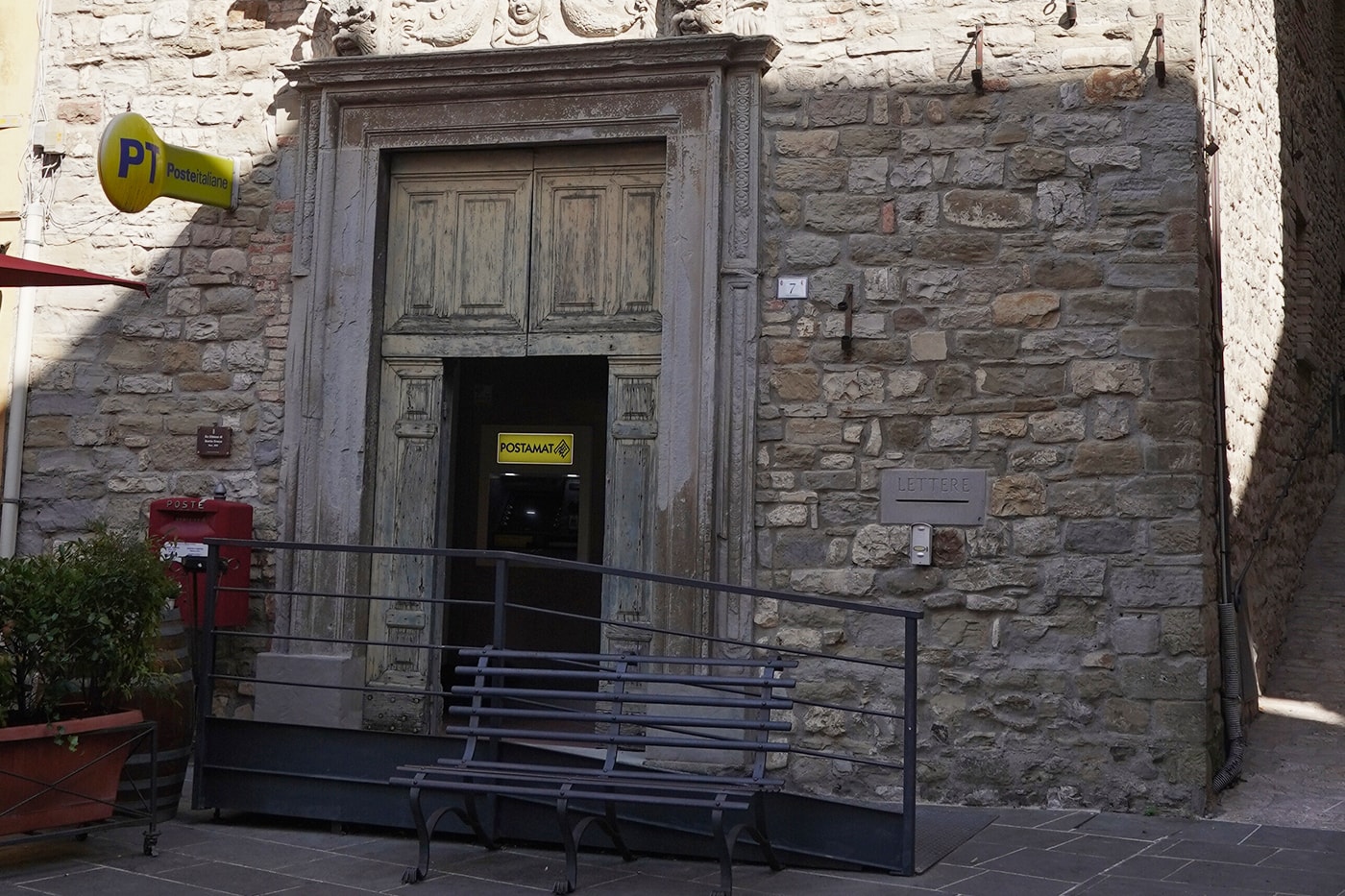
In 1170, Countess Odolina donated a piece of land (horto) to the Benedictine Abbey of San Bartolomeo di Camporeggiano, for the monks to build a church dedicated to the Holy Cross. They set about building the church with the monastic priorate. As early as 1227, Santa Croce was one of the “official” places where public and private deeds were registered and until the church of Santa Maria Nuova was built, it played a central role as a place of worship. In 1595, the apostolic visitor Monsignor Fabio Tempestivo declared that the little church was too small. He ordered the canons who lived there to transfer celebrations to Santa Croce, situated in the public square. It was very popular with the people because it was “more appropriate, more convenient and, above all, larger”.
In 1611, the church was enhanced when the Vitelli family commissioned Denis Calvært, the only Flemish painter in central Italy at the time, to paint The Last Supper which is now preserved in the Collegiate Church of Santa Maria Assunta. When the Collegiate Church was enlarged and restored in 1657, Santa Croce lost its supremacy and gradually fell into disuse.
Following various renovations, the appearance of the church had changed considerably. The most recent evidence of a previous façade dates back to the 1940s. Almost entirely made of brick, it featured two pairs of pilasters on either side of the surviving portal. The decoration of the latter, dating back to the second half of the 16th century, is rather unusual for a church entrance: on the lintel which has protruding mouldings interspersed with festoons featuring plant motifs, seven masks with horrible mouths are arranged symmetrically, three above each jamb and one in the centre. This decoration seems more suited to the entrance of a theatre, than that of a church.