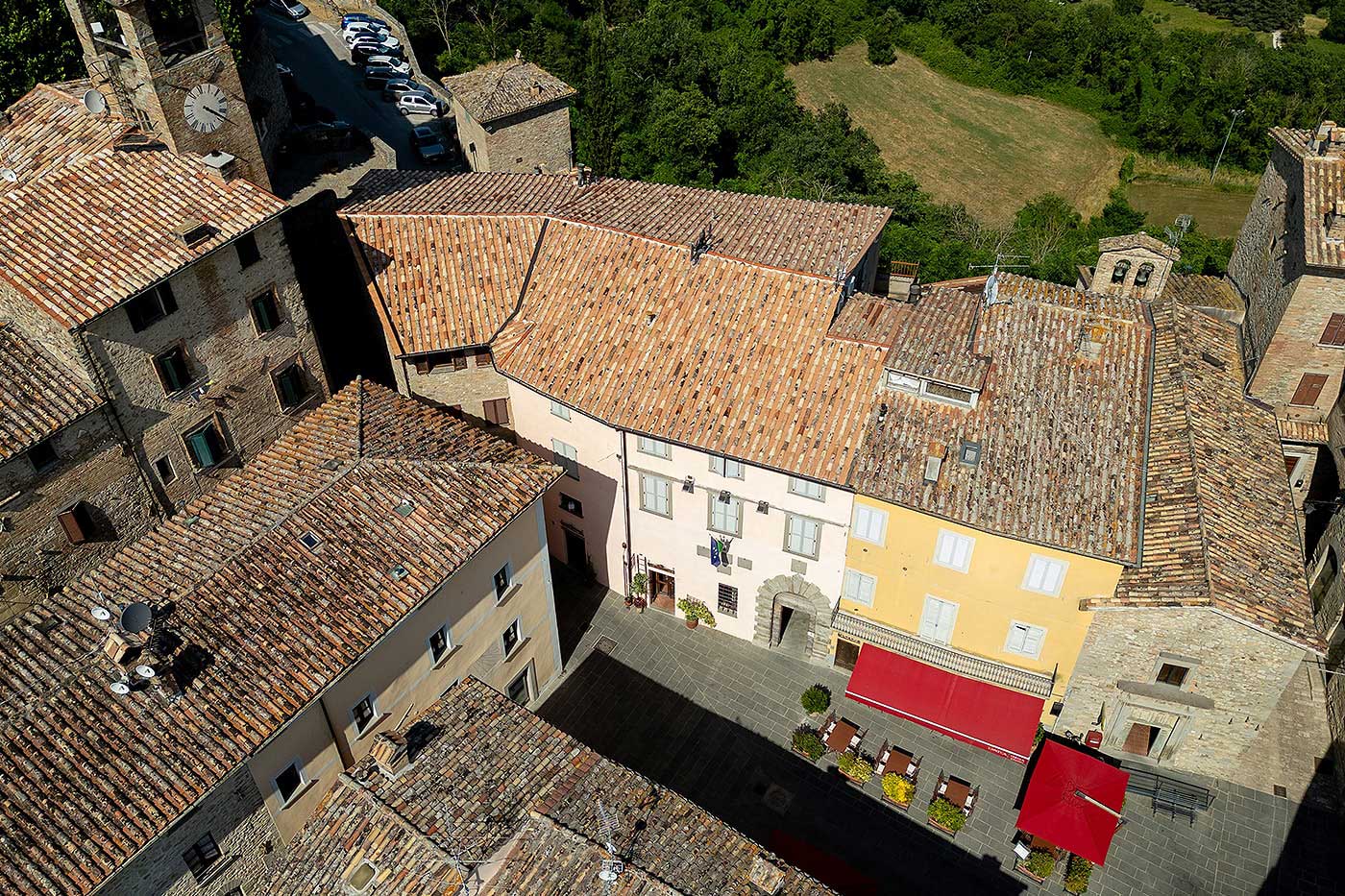
The municipality’s historical archives contain no documents old enough to provide unequivocal evidence of the town hall’s construction, or its original location. The section facing the large Porta del Borgo gate has certainly been part of the current building since 1453. It is likely that it was built at the same time as the tower, i.e. in the 13th century. In 1342, the building had a flight of steps that led directly from the square. In fact, the community’s announcements were made by town criers on the steps of the building. In addition, a specific provision of the 1342 statute stipulated that the town hall could not be sold under any circumstances, in perpetuity.
The council chamber, accessed directly from the steps leading to San Francesco, overlooks three large single-lancet windows outside the city walls, and arranged symmetrically above the Porta del Borgo. On the opposite wall, a poorly preserved fresco depicting the crucifixion, bears the date 1453 in the inscription below.
In the 16th century, the building was enlarged during the marquisate of the Vitelli family, in accordance with the style of that time. The new layout can be surmised from the rusticated stone portal, and the elegant stone corbels of the ground floor vaults. In the entrance with its high barrel vaulted ceiling, the municipality’s stone coat of arms is preserved. Depicting a rampant ram and dated 1486, it probably adorned the external façade above the Porta del Borgo.