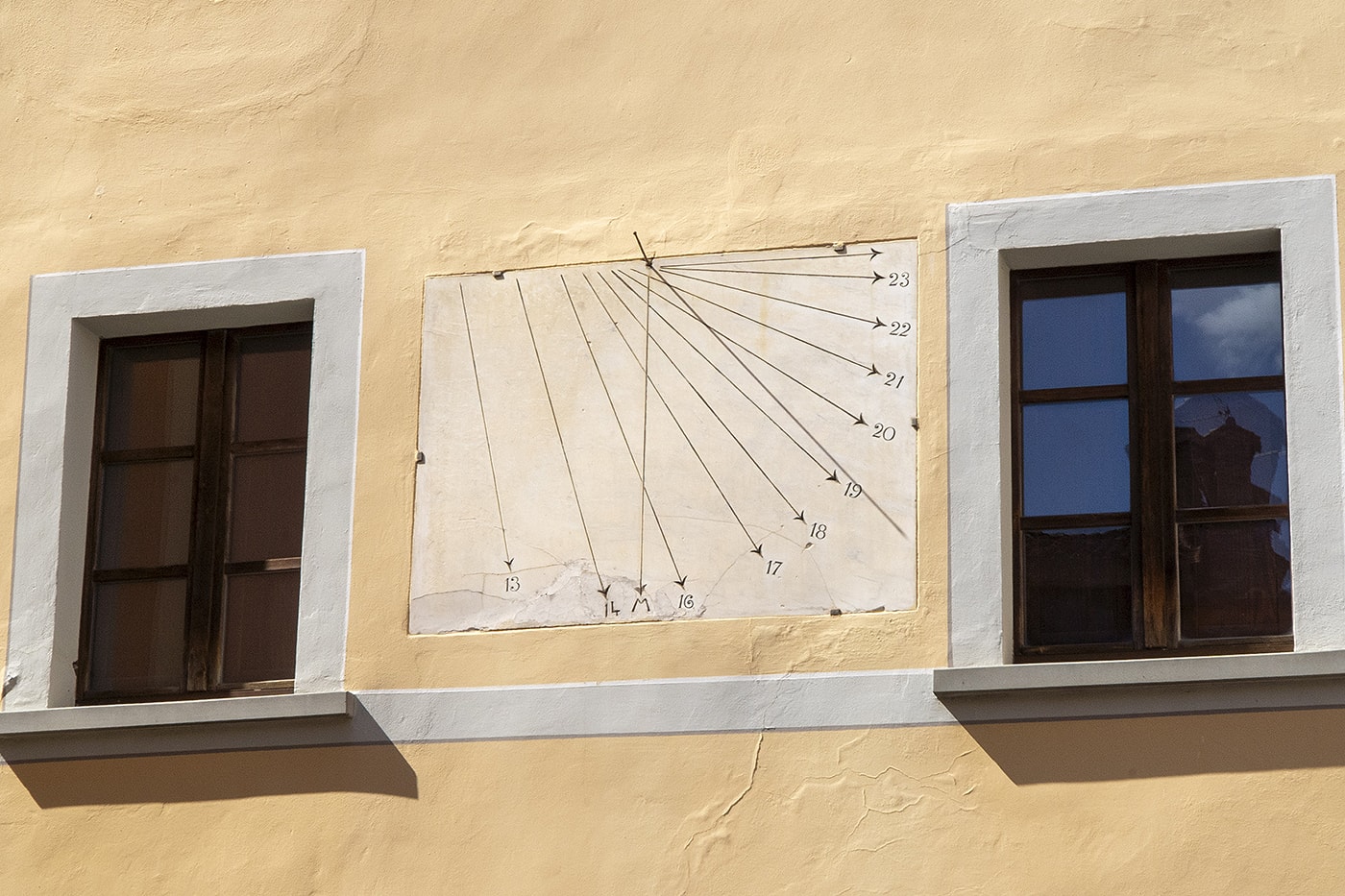
The Meridian sundial in the square of Montone belongs to the tripartite sundial type, known as italiche hours They follow the canonical hours, brought back into use by the Benedictines in the sixth century and still in use in the sixteenth century; they precede the French hours, which became established in Italy in the mid-19th century. The italiche hours were introduced in the West around the 13th century and are based on the so-called equinoctial system, which involves two important innovations:
1. The construction of the first mechanical clocks allowed the day to be divided into 24 hours of equal length (hence the name equinoctial, as the constant length of the canonical hours was in fact only found on the days of the equinoxes)
2. Time was measured from sunset as was customary in the East.
The sundial in the square of Montone consists of a vertical dial with italiche hour lines, a midday line and a stylus on the wall. If the shadow of the tip of the stylus falls on line XVIII, for example, it means that there are six hours left until sunset (18 + 6 = 24), the twenty-fourth and last hour of the day. This method of counting was functional to life in medieval villages where the gates closed at sunset; work in the fields ended at the twenty-third hour. One of the main disadvantages of dividing time into italiche hours was the extreme variability of the concept of sunset which, depending on the horizon of the place, could differ significantly even at a distance of a few kilometres. The sun sets earlier in a valley than on a ridge (at a higher altitude).