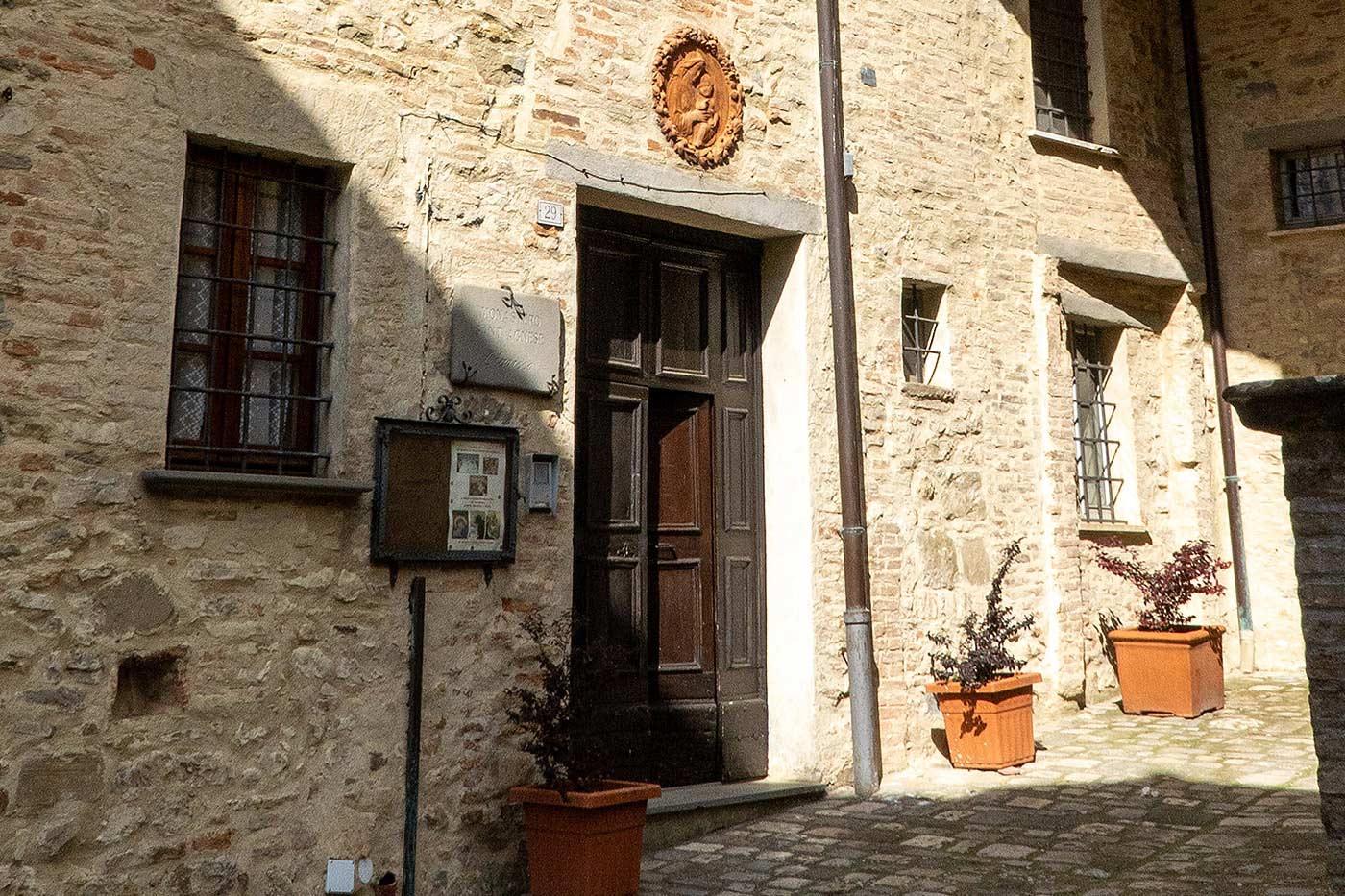
In the 15th century, following the spiritual renewal promoted by the blessed Angelina da Montegiove, communities of pinzochere (lay women) sprang up all over Umbria. They lived communal lives of piety and penance, outside the cloister. The existence of a pinzochere community in Montone is documented as early as 1492, when the sisters lived in the house of a certain Giovanna Iuliani de Caunis, in accordance with the rules of the Third Order.
The monastery which was purchased in 1560, thanks to the support of the municipality, was located in the Porta del Monte district. It was originally dedicated to Saint Elizabeth of Hungary.
In 1571, when the apostolic visitor arrived to enforce the canons of the Council of Tridentino, he imposed a cloistered life on the nuns. He did, however, assist them too; as the sisters were living in extreme poverty, the apostolic visitor decided to tax the very wealthy Compagnia del Gonfalone.
At the end of the 16th century, the name of the convent was changed to Sant’Agnese. Then, in 1611, the sisters were able to purchase the adjacent house, owned by Antonio Olivi, in order to enlarge the convent. Thanks to the support of various generous benefactors, they acquired many properties and were finally able to overcome their financial difficulties. In 1669, there were 14 nuns in the order.
In the 19th century, the nuns were forced to leave the convent as a result of the suppression of religious orders. Following the period of suppression by Napoleon, the nuns had to return to their homes; in the second period of suppression which came about after the unification of Italy, they were forced to leave the monastic building and together with the Benedictine nuns, to move to Santa Caterina.
They finally returned to their headquarters after buying it back in 1895. Since then, the monastic community has been a lively presence in Montonese society. After the First World War, they cared for orphans and ran a nursery school up until the 1970s.