
The Fortress Ruins (14th-15th century)
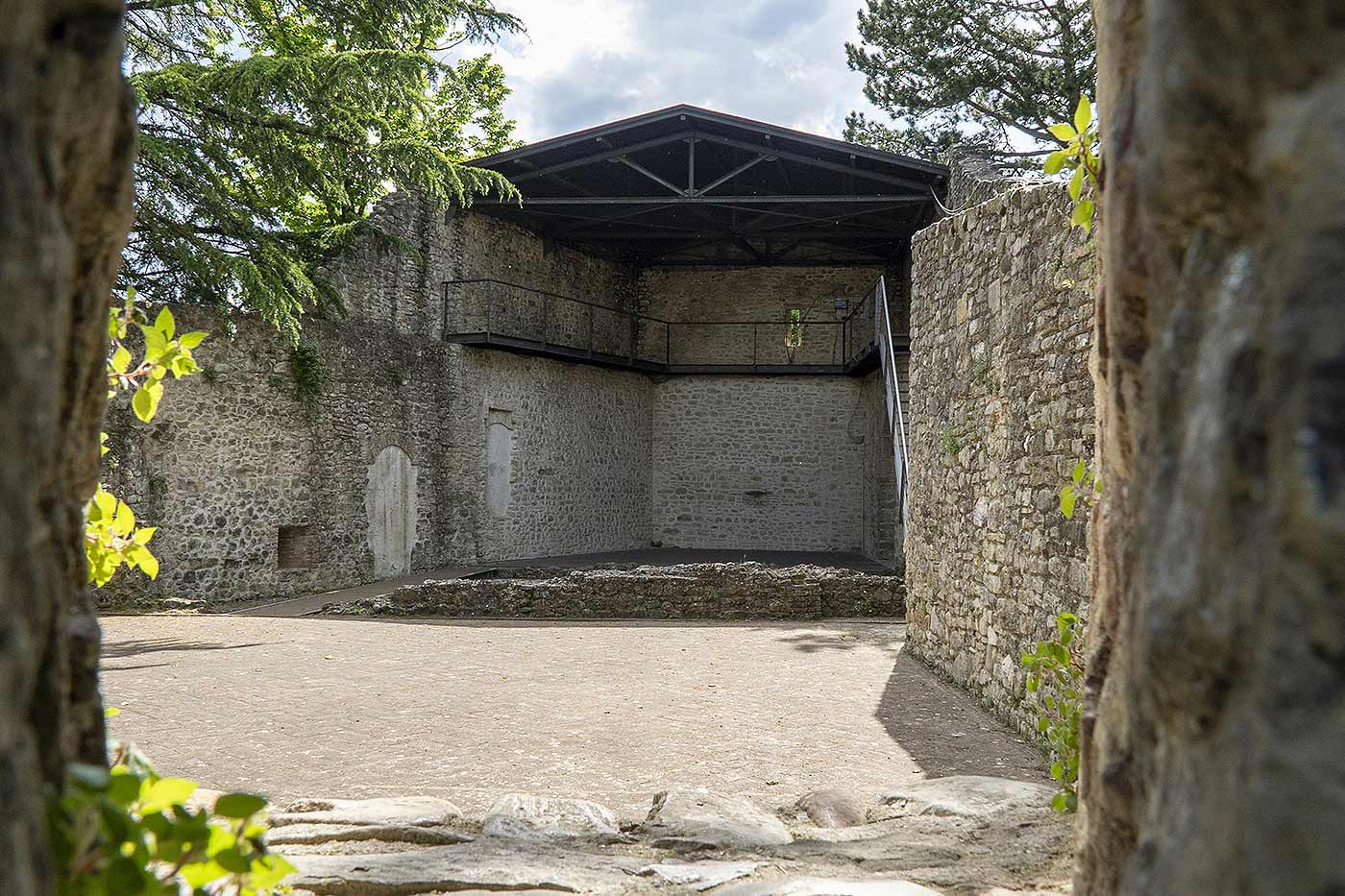
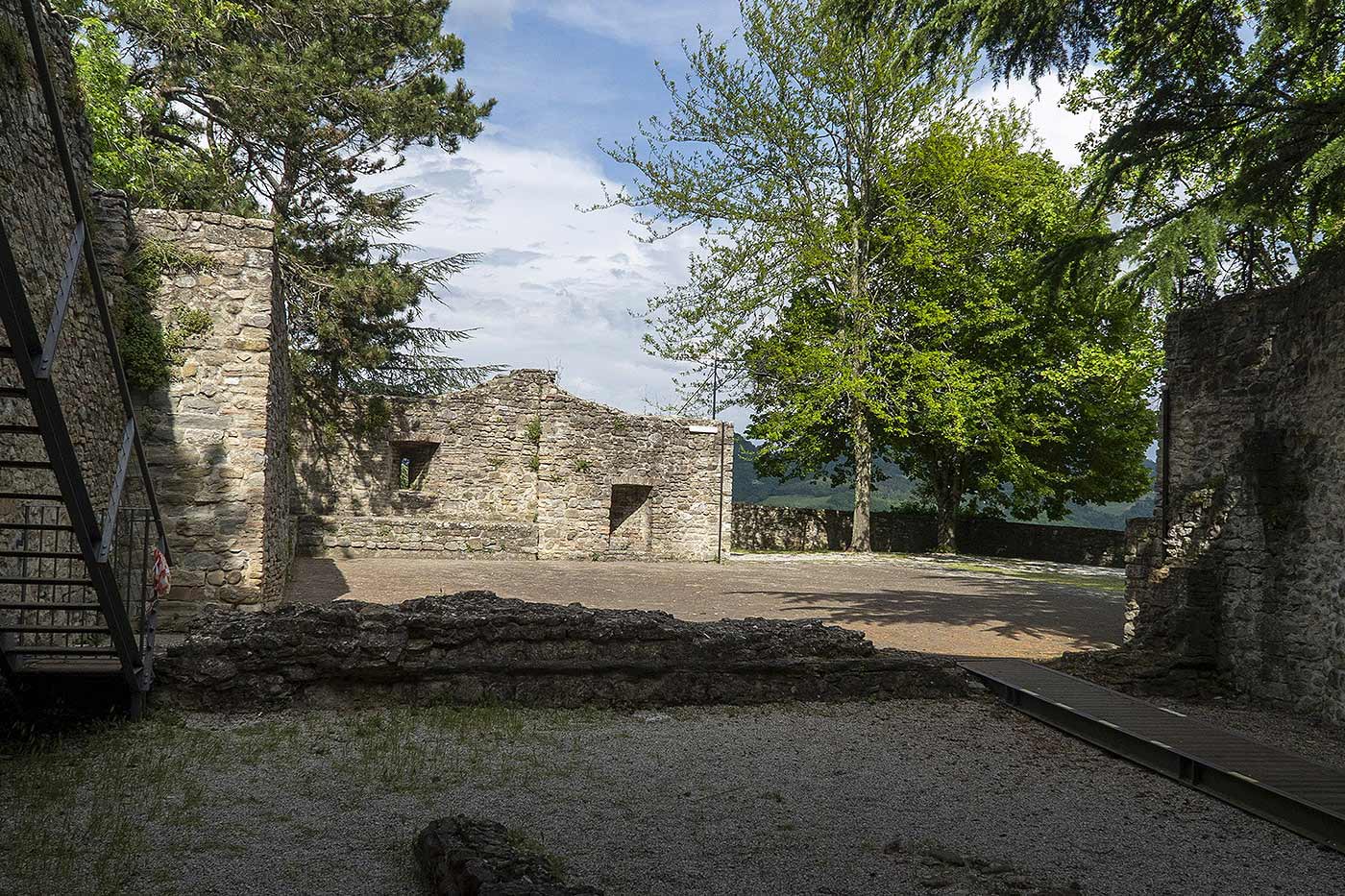
The fortress was built in the 13th century, on the highest hill on which Montone stands. It had become necessary to protect the town after its rapid expansion, with a wider circle of walls which also took in the hill of Monte. We don’t know what it looked like at that particular time, but thanks to the archives, we have a good idea of its appearance in the following century. In the 15th century, Bartolomeo Caporali depicted it at the foot of his work, the “Madonna della Misericordia” which is held in the Municipal Museum. In 1374, Ugo dalla Rocca, governor of Perugia for the county of Porta Sant’Angelo, wrote a detailed report outlining the various fortifications to be built in order to improve Montone’s defence. In 1378, the people of Perugia ordered Oddo Fortebracci to renovate the fortress as part of a penalty. This included constructing a new curtain wall at the base of the entire settlement, that stretched from south to west. In the centre of the fortress, there was a huge tower whose original foundations are now marked by a square brick structure in the centre of the garden. There was a large cistern inside for collecting water, and spacious underground rooms for storing food and weapons. The mansion of the Fortebracci family stood next to the fortress. When Braccio da Montone became Count of Montone in 1414, and then Lord of Perugia in 1416, both Montone and Perugia benefitted from important initiatives in both art and engineering. Fortification and decorative work was once again carried out at the fortress, and also at the mansion next door. The Count of Montone entrusted this particular renovation to the Bolognese architect, Fioravante Fioravanti, who had previously built the Cava del Lago Trasimeno and the loggias for the Count’s mansion in the piazza in Perugia.
After Braccio’s death in L’Aquila in 1424, the county passed to his son Carlo, who was only three years old at the time. It was ruled by his mother, his cousin Niccolò della Stella, and Niccolò Piccinino until he came of age in 1440. Following in his father’s footsteps, Carlo Fortebracci spent his life far away from Montone which was ruled by his wife, the regent Margherita Malatesta.
Relations with the Holy See soon deteriorated, and the good favour of the people of Perugia began to wane. Eventually, Pope Sixtus IV ordered Federico da Montefeltro, Duke of Urbino, to return the Castle of Montone to the Papal States. On 25 September 1477, after a month-long siege and the destruction of the Rocca tower, Montone surrendered. The Pope, however, was still feeling dissatisfied and insecure; the following year he had a select group of sappers destroy both the fortress and the Counts of Montone’s mansion, as well as a large portion of the walls.

Discover one of the most beautiful villages in Italy
©2025 Montonein | Cookie Policy | Privacy Policy
site created by Made in Italy Lab