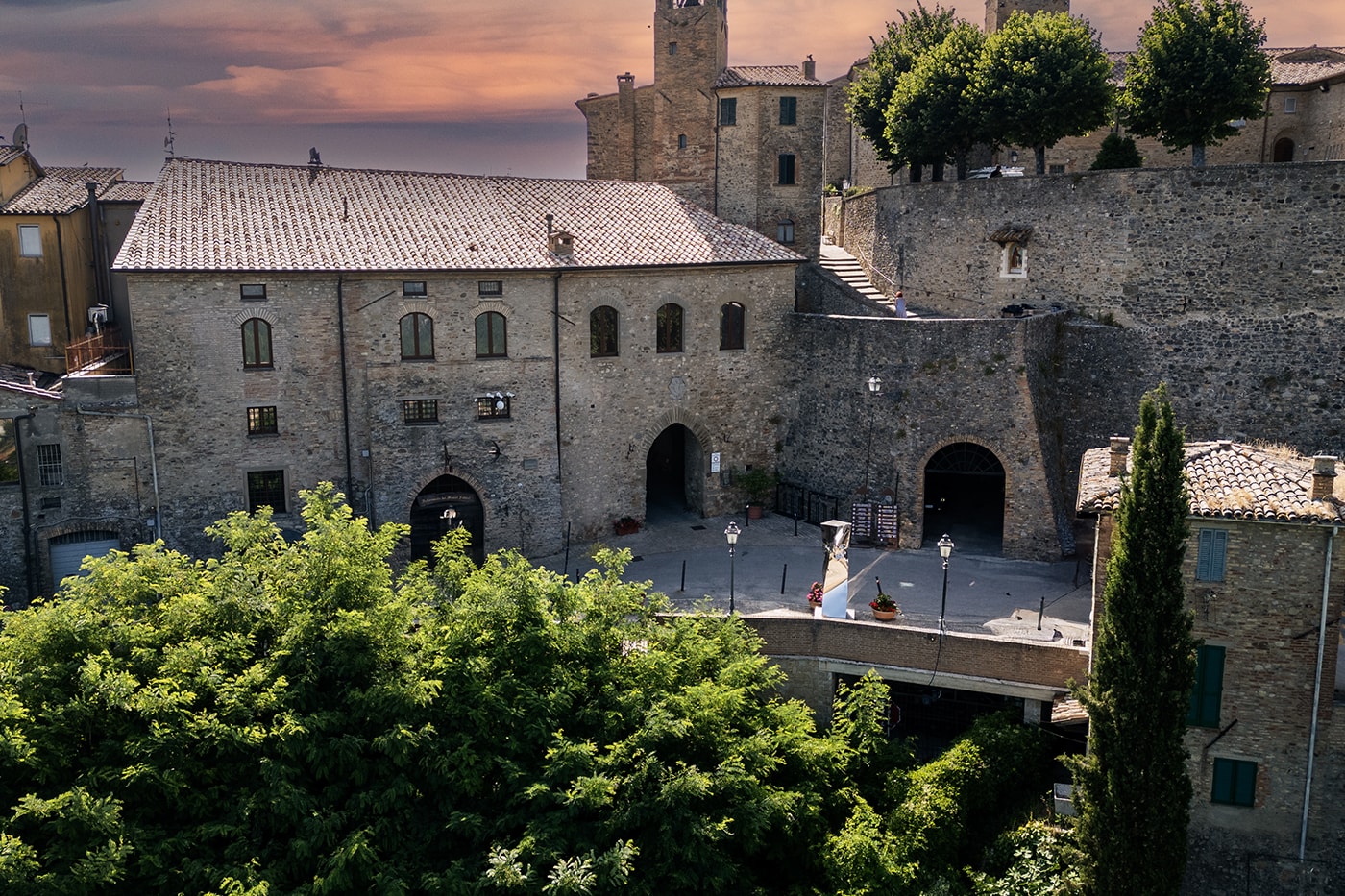
The Porta del Borgo is the entrance to the town from the north-east, through the medieval walls and leading directly into the public square. The ancient town hall stands on this square, with the windows of the council chamber symmetrically arranged above.
It consists of four large arches supporting a wooden entablature ceiling. The oldest two central arches, made of local sandstone and supported by strong pillars, have a round arch and are considered to be contemporary to, or immediately preceding, the construction of the civic tower between the 12th and 13th centuries.
The internal arch, also round-arched, underwent renovation work during the expansion of the building in the 16th century, but its current appearance dates back to the 19th century. At the top of the arch facing the square, a commemorative plaque was added in 1904 in honour of Giuseppe Polidori, one of Garibaldi’s “Thousand” (Garibaldi’s “mille”), created by the Perugian sculptor Angelo Biscarini.
The pointed arch which faces outwards and is narrower than previous ones, is later (restoration work was ordered on the building in 1357) and was modified over time strictly for defence motives; in 1374 Ugo della Rocca, the governor of Perugia who was in charge of the fortifications and defence of the castles in the countryside of Porta Sant’Angelo, including Montone, even ordered the permanent closure of the Porta del Borgo.
This access to the town worried Count Carlo Fortebracci who, in 1468, sent a letter from Chiari ordering the Council and the Domini sex to fortify it with major external masonry works: a rampart, a large external wall from the village gate as far as the tower of San Paolo, incorporating the well that the people of Montone called ‘pozzo dietro’ (the well behind) into the walls. This was all to be built with funds left for this purpose by Niccolò Piccinino, along with a personal contribution from the count.